

 Posted by
 - Need for continuous professional development for teachers

It may sound funny, but it is possible to be an eternal outsider floating aimlessly about in one’s education journey. In other words, a person being taught may continue to be groping perpetually, hopping from one disjointed lecture or subject to another without a useful end in sight.
Let’s consider this analogy: when bees hop from one dazzling flower to another, they collect nectar for a feasible purpose: to make honey. So, their business makes sense. There’s something to show for it! It’s worth the time spent! And that, by the way, is providence at its best, showing how to be eternally fortunate.
The idea that a nation’s education can be aloof and defeatist can be a very disturbing matter considering the expectation that education helps to make sense of one’s life. But, the wrong type of teaching can be quite damaging! And, frankly, countries that persistently stay passive and poor ought to come to grips with that anomaly.
Preparing properly
Patrick Awuah of Ashesi University once said: “We need to be educating people who are going to be inventors who create solutions for our local problems, and not depend on outsiders.”
He added, “In my professional experience, I joined Microsoft at the time when there were 3,000 employees. I left eight years later, and there were 30,000 employees with annual revenues greater than the GDP of Ghana; and this, to me, was an incredible phenomenon! The revenue was bigger than a country which, at the time, was about 20 million people. The equipment they used is not all that expensive, and there is no reason why we couldn’t create software companies in this country if we prepare people properly.”
How, then, do we prepare people properly? Many adults may recall that throughout their elementary and secondary education journey, not often were their views or opinions asked for, even at the university level. The teachers were often too keen and busy providing knowledge to be reproduced back to pass exams.
That detour may be understandable in the context of the olden days when information was quite scarce, and sacrosanct almost. But today, with Google at our finger tips providing every kind of information by merely clicking buttons, why not adopt a shared responsibility and situate the learner in the driver’s seat right from the beginning as a teaching habit?
Learner centred teaching
The New National Pre-Tertiary Education Curriculum Framework was written to defuse that archaic stuff. The primary role of the school leader therefore involves maintaining a clear focus on learning as series of activities. This demands that the learning environment encourages a culture that promotes a shared sense of leadership, purpose, and accountability, with learners participating in the thick of it.
Pedagogy refers to the interactions between teachers, learners, and the learning tasks. This broad term includes how teachers and learners relate to each other in the instructional approaches used in teaching sessions. Pedagogical approaches are often placed on a spectrum from teacher-centred to learner-centred pedagogy.
The two approaches can often complement each other in the realisation of educational goals. A teacher-centred approach helps to introduce a new theme, while a learner-centred approach necessitates allowing learners to explore ideas and develop a deeper understanding, and acting on that knowledge.
To be effective, teachers must carefully plan and implement appropriate learning tasks with students at the center of it, not on the periphery.
Teacher-centred pedagogy positions the teacher at the centre of the learning process and typically relies on lectures, rote memorization, and chorus answers. This approach demands learners to complete only lower-order tasks, without daring to express opinions or focusing on their interests.
The learner centred teaching approach is student-centred, participatory, active, suggesting learners should play an active role in the learning process.
Nurturing and using both teacher and students’ talents in this way creates a virtuous circle of motivation to learn more. Working collaboratively to resolve common challenges is a powerful instrument of change.
Students seeking solutions
Proper education is not only for social and emotional growth, but also for economic awareness, the gain useful skills to contribute to society in this dynamic 21st century. It must appeal to what curiosities and interests the learners themselves bring to the educational experience.
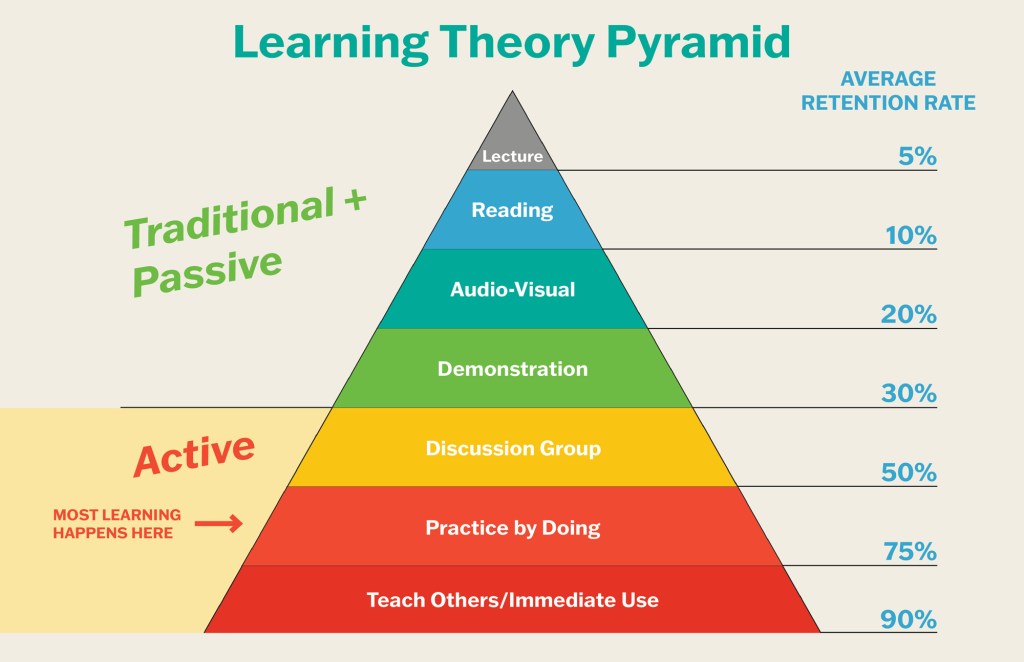
An education renaissance is long overdue to save the children, the youth, and the larger nation. As the Learning Pyramid shows, there’s a place for passive activities such as lecturing, and so on; but to help people make greater inroads and build their confidence in leaps, they must be positioned in active roles with opportunities to lead discussions, and even teach and learn from each other as peers.
At the end of the day, when people generally discover intrinsic motivation, that serves as the springboard for greater achievement. A recent joke by a certain preacher went this: Give $20,00 to an illiterate Chinese, and he’d start a fish farm, and soon become rich. Give the same amount to our college educated person and they’d write a report about the advantages and disadvantages of fish farming.
Not only that, but the national ethos itself will rather spend huge amounts of dollars for land cruisers for officials. That should not be surprising: In many ways, we were educated all the way through our traditional universities as fantastic theorists, fit for the comforts of cushioned offices, but never as great doers. And all that has to change.
Email: anishaffar@gmail.com
copyright© 2016-2023, anishaffar.org
Discover more from
Subscribe to get the latest posts sent to your email.
 anishaffar.org