

 Posted by
 How the winds of change are dawning a bright new era
I recall some history lessons from my youthful days at St Peter’s Elementary School, Kumasi, in the 1950s, when we were first introduced to the genealogy of the Asante Kingdom from the late 1500s.
That history continues to showcase the consistent reigns including notably Nana Oti Akenten (1630-1640), Nana Osei Tutu I (1701–1717), Nana Prempeh l (1888–1895), Nana Agyeman Prempeh II (1931–1970), Nana Opoku Ware II (1970–1999) to Nana Osei Tutu II (1999–present).
The consistent unbreakable succession line from the 1500s all the way down to this very day is most remarkable. That fact, in itself, spoke volumes about the tenacity of this noble African kingdom, and the ability of Africans to live and thrive mainly by our own institutions.
Gold Coast Native Institutions
A prized possession in my library is J.E. Casely Hayford’s eloquent seminal book, “Gold Coast Native Institutions: With Thoughts Upon a Healthy Imperial Policy for the Gold Coast and Ashanti”. First published in 1903, the author argued fiercely against the British colonial government’s tendency to disregard the order and customs embodied in indigenous institutions that had prevailed and served the indigenes for centuries.
He started the first chapter with the following remark from a former administrator of the Gold Coast who, luckily, happened to be conscientious: “these colonies, even the smaller ones, are countries often as large and full of people as many a place in Europe which holds a niche of its own in world history … These latter countries, however small they may be, are deemed important as the homes of people who are, or have been, factors in the political and social questions of the day.”
With many notable institutions in Ghana named after him, Casely Hayford was a most astute thinker in his day. He wrote that since we now have the British with us, the object of an enlightened government should be “to promote the healthy national development of the governed by conserving and not destroying the institutions of the people.”
He agreed with the Russian philosopher, Leo Tolstoy, who cautioned against the mistake of the colonialists “always assuming that Western institutions are stereotype models upon which all forms should be based.” It was clear to both men that that delusion “is at the bottom of half the wars carried on by Europeans against men of other races.”
It stands to reason that if reforms were needed, the measures must suit those indigenous people and not opportunists. The assumption that so-called reforms must be constructed exactly upon Western models was opposed to common sense, both thinkers agreed.
In advising the colonial government, Casely Hayford asserted: “You have disorganized our institutions, you shall help to reorganize them; you have enriched your homes with luxury that the Gold Coast has afforded, you shall help us to rebuild our home; you have made here princely fortunes, you shall help us to live peaceably in our own vineyards and under our own fig trees’’
Winds of change
The recent visit by Otumfuo Nana Osei Tutu II to celebrate the Emancipation Day in Trinidad and Tobago was a clear signal for a consciousness awakening. The event marked the day that enslaved Africans throughout the British Empire were finally liberated from the bondage of slavery.
The following announcement set the tone: “All the way from West Africa, Ghana, let’s welcome our special guest for Emancipation 2023, His Majesty Otumfuo Osei Tutu II, Asantehene, King of the Ashanti Kingdom.”
According to the Office of the Prime Minister, the 16th monarch of the historical Ashanti empire expressed eagerness to visit Trinidad and Tobago – and anticipated the establishment of an Ashanti village to strengthen the linkages between the Caribbean and Ghana.
In his deliberations, the king hailed those who advocated African pride such as Marcus Garvey and Trinidad-born C.L.R. James who had inspired Ghanaian independence leader Kwame Nkrumah and the South African freedom fighter and former president Nelson Mandela.
Meeting the Otumfuo
Years back, I was first introduced to the young king-to-be in London by another Ashanti royal, John Prempeh Bonsu, when I was visiting from California. John and I happened to be form mates at Mfantsipim School where we met in September 1961. We became quite close like blood brothers ever since. But to think that to this day the young king remembered our very first meeting!
I was quite shaken when – at the large Akwasidae Durbar, on the Manhyia grounds, Kumasi – on being introduced to the king, in state – before I stepped up for the hand shake – he announced to the large durbar, in Twi: “Anis wo hen? Mo mma no mbra. Me Nana ne no!” [To wit: “Where’s Anis? Let him come. He’s my kin!”
Though not a shy person by nature, that kingly welcome jolted me completely. That memory was quite a celebration for both of us. Later in chambers with the king, he was to say, in Twi: “Obiaa aba aba hwe hwe me. Aka wo.” [In short: “Been waiting to see you.”]
He was to add: “I read your columns in the Daily Graphic. The nation is thankful for all you do for education! Continue the good work.”
I’m naturally an extrovert; but this encounter was different. I whispered to the king, “Nana, meda bia.” [Nana, I will sleep well tonight!]
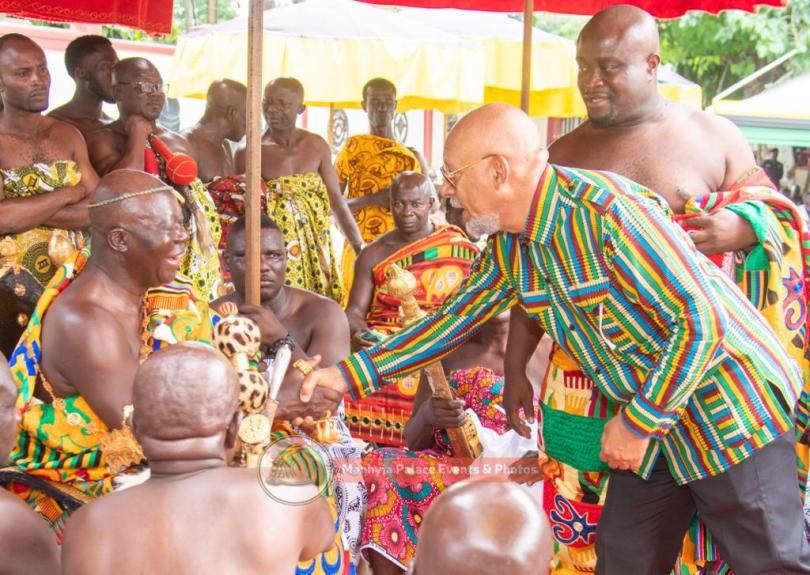
Meeting Asantehene Otumfuo Osei Tutu ll
Email: anishaffar@gmail.com
copyright© 2016-2023, anishaffar.org
Discover more from
Subscribe to get the latest posts sent to your email.
 anishaffar.org