

 Posted by
 Moses Baiden speaks at Mfantsipim annual lecture
Held 11th October at the auditorium of the Ecobank Ghana head office, Accra, the 2023 MOBA Annual Engagement Series was moderated by Prof Ebow Bondzi-Simpson, a former rector of GIMPA. Other speakers included George Acheampong, Nana Dr Annan Afer l, and Dr Christian Owoo.
Moses Kwesi Baiden, Jr began his address “Identity, Digitization, & Access to Quality Education” by exploring identity in the analog world of yesterday. In the past, his mother, a retired teacher, used to group her students by sections, denoted by colors: blue, yellow, red, and green.
School attendance was recorded in large heavy ledgers. Upon entering the classroom, names were called out, and hands were raised to confirm attendance. Such analog matrices have remained largely the same to this day.
In the wake of this new age, however, we are now transitioning to a new world where everything we once knew has transformed. All that we used to deliver in the old ways have now been digitized, including our identities, electronically.
Digital identity
Identity typically begins with a legal foundation rather than a technological one. The law defines whether you are a Ghanaian, a foreigner, a refugee, or stateless, and this information forms the basis for your primary identity information, typically associated with a passport dataset. Biometric data is then linked to this information to create a legal identity.
Baiden noted that in the past, a legal identity could be manually verified. Nowadays, we can do this digitally, either physically or remotely. In the same way, a well-functioning educational institution today, for example, can use biometrics to gain access, whether physical or digital.
This electronic identity is stored on a card or credential, which can then be loaded onto our devices, such as mobile phones. In a secure and modern institution like Mfantsipim, when you leave for school in the morning, we know that you depart at 8:00.
This helps to track punctuality. When you enter a classroom, you pass through a turnstile or an access control system, confirming your presence in class. When you access an exam paper remotely, such as a multiple-choice test, your score is already registered when you leave.
Today teachers can analyze the entire curriculum and identify students’ strengths and weaknesses in real-time. This kind of analysis, which can be done for a thousand students, would take just a fraction of the time it previously required. Computers or AI can pinpoint students’ problem areas.
Digitalization
He observed that digitalization will usher us into a world where identity provides us with remote access. It will also connect us to the world’s knowledge centers, making information available to us, whether it has already been created or will be created in the future.
To grasp this concept, we must differentiate between digitization and digitalization. Google’s mission initially was to document all the world’s information and create servers for access.
This concept spurred other tech companies to digitalize processes that had previously been done differently, leading to transformative changes. For instance, ride-hailing apps like Uber eliminated the need to wait for taxis; all it takes is entering the app, providing your ID, and selecting Uber, which then knows your location. The same principle applies to education.
So, when we digitize data and information, including the 150 years of Mfantsipim’s history – for example – and its entire curriculum, they can be available in real-time to students worldwide. In a nutshell, one can even hold an Artificial Intelligence (AI) class at Mfantsipim from a school in Stanford University, California.
Digitalization provides an advantage to every country. The question, however, is how we transition from our current challenges to the goals we hope to achieve in the digitalized world.
Access, data, digital tools
According to the 2021 cumulative census, only 41.8% of our population has access to secondary education. This is indicative of our low digital index ranking, at 88%, which significantly affects our quality of life, considering also that a staggering 81% of the children lack access to the Internet.
Access is constrained because our digital index needs improvement. Our classrooms are overcrowded, and our ICT resources, while present, are outdated. Mfantsipim, with its 3,700 students, falls short when compared to global education benchmarks.
Nonetheless, these problems can be resolved. The link between digital identity and the quality of sustainable education enables us to collect data for real-time analysis using AI tools, digital tools, machine learning, and large language models.
With these tools, Baiden said, we can assess on a day-to-day, minute-by-minute basis how our actions and inactions impact education in real time. We no longer require soothsayers or fetish priests; we simply need data. By measuring these metrics and applying them to the future job market, we can tailor education to the relevant jobs. Education without a nexus to match capacity is futile.
Competencies
Baiden noted that the jobs of the future are based on competencies. We need to identify these competencies to achieve our goals predictably. There are approximately 30 competencies, including artificial intelligence, machine learning, quantum computing, large language models, and, most importantly, cryptography.
Identity and cryptography ensure that computers cannot tamper with or forge your identity. If identity can be faked, then all the digital benefits mentioned become null and void. Quantum-proof cryptography is the key to this.
He noted that our children should be trained in these competencies. He believed that one of the most significant jobs of the future is prompt engineering which entails asking artificial intelligence platforms the right questions to obtain the best answers.
He concluded that artificial intelligence was not going to bring about the end of the world; it’s merely a tool for problem-solving. At this historical juncture, our present actions will shape the future.
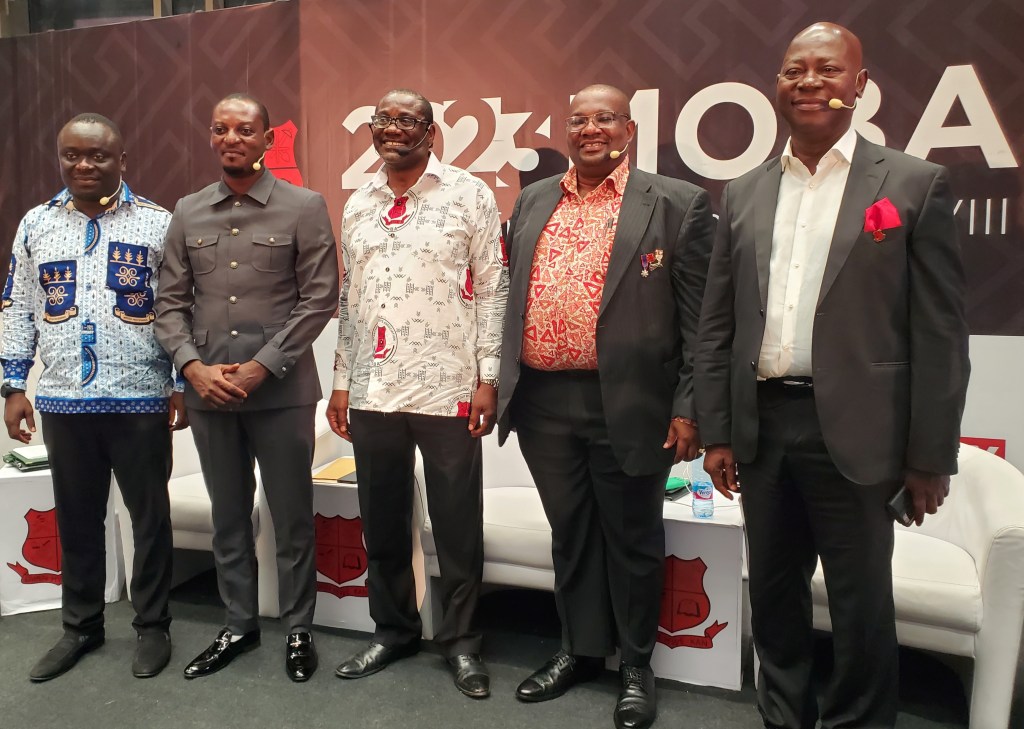
The panel from left: George Acheampong, Dr. Annan Afer, Prof Ebow Bonzie-Simpson, Dr. Christian Owoo, Moses Baiden Jnr.
Email: anishaffar@gmail.com
copyright© 2016-2023, anishaffar.org
Discover more from
Subscribe to get the latest posts sent to your email.
 anishaffar.org