

 Posted by
 Anis Haffar’s remarks at the Launch of Francis L. Bartels’s Posthumous Book, “MFANTSIPIM: A Headmaster Remembers” at Wesley Towers, Accra on Wednesday, July 2, 2025
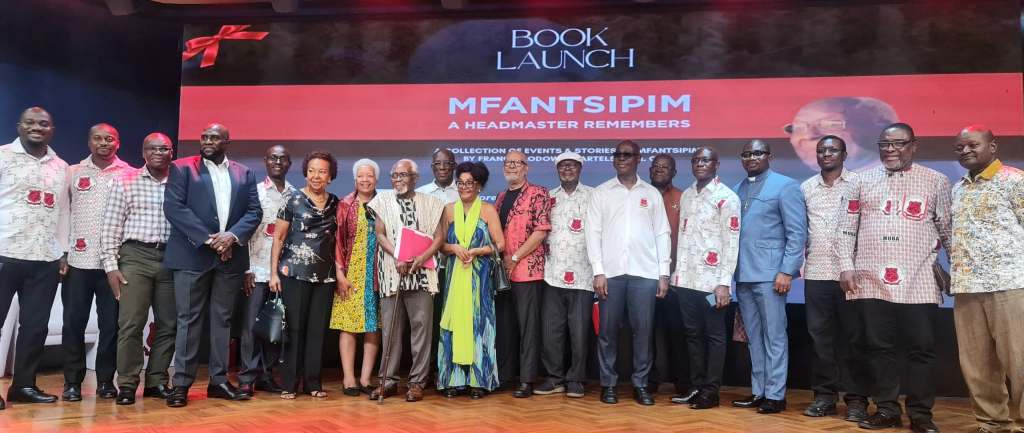
Distinguished Ladies and Gentleman: Old boys and girls:
I’ve titled my remarks, for this occasion, “Francis L. Bartels: The great headmaster I was destined to know.”
My relationship with Headmaster Bartels evolved from headmaster and student – to father and son. We were always happy together. We shared so much in common as educators. As I’ve told both Agnes and Carlien, “You are my sisters, whether you like it or not. Apa is my father too.”
Way back some 64 years ago, I remember as a greenhorn, my very first walk through Cape Coast on Commercial Street and London Bridge – from Mfantsipim to the Methodist Book Depot. That was in September 1961. I was in the company of a couple of mates who had also arrived at Kwabotwe from Kumasi.
We were dressed in white-white: a white pair of trousers with two handkerchiefs in our pockets, a white shirt with the Mfantsipim red and black-tie, and polished black shoes adding splendor and color to our appearance. We were new to Cape Coast, and rather raw, naive and apprehensive in that new environment.
An incident that followed rocked my very core. As we are approaching some women on a sidewalk at Kotokoraba, I heard one of them whisper: “Bartels ne mma na wore ba noo.” In English, “Those are Bartels’s children coming”. She was pointing at us.
Right there and then my chest stretched out by an unforseen force; my steps – in turn – adjusted themselves accordingly. My whole aura responded royally. Out of the blue, we were being celebrated. I felt taller than my teenage height would allow. Not once in my life had I been so recognized and validated.
I had not yet met the headmaster. He left for a post at UNESCO in mid-1961 so when I got to Mfantsipim later in September that year he was already gone. As fate will have it, I was to see an advert that announced the launching of his book, “The Persistence of Paradox: Memoirs of F.L. Bartels.” This opportunity brought me to the Teachers Hall, Accra, September 24, 2003.
And there he was, seated on a dais in a company of Rev Prof Kwesi Riverson, Dr J. A. Addison, and Kwame Gyekye, a professor of philosopher. At the launch, he gladly autographed the copies I bought. That was the very first time we met face to face.
We seem to know Headmaster Bartels mostly as a headmaster, but he was also a most prolific writer. The authenticity of his ideas and reflections were so refreshing that I published a review of the book, and titled it, “That Lucky Old Son,” mimicking the title of a Jazz track by the iconic trumpeter Louis “Satchmo” Armstrong. I noted the following: “Bartels’s vigour [was] a surge of inspiration and a clarion call to measure to the top, and appreciate the twin-tower of perseverance and leadership. Mfantsipim was the richer having claimed landmarks from it.”
Then, at the grand age of 98 years, Headmaster Bartels released yet another masterpiece: “Journey out of the African Maze: Indigenous and Higher Education in Tandem.” Before the release, he had sent me the original transcript for my comments. There was absolutely nothing I could add or subtract, and I told him so!
In a published review of that book, I commented: “The grand ol’ man has now clocked 98 bold years, and he’s still not about to rest from his labours. For him, there’s no such thing as letting your thoughts stiffen. Close the mind, and the body mass itself begins the rusty descent into decay. For him, study was never a chore, but a vibrant responsibility and a pleasure.”
Someone must have sent him a copy of the review. He emailed me from Paris, thanking me for it. He wrote the following: “Dear Haffar … You will be glad to know that a French friend of ours said, on reading your review on the internet, that she could sense that the author of the review had culture behind him.” He added, “That complement coming from a retired [senior official of the] Ministry of Education, France, is not to be sneezed at … Best wishes! FLB.”
He then invited me to Paris to visit him. But, for some reason, I couldn’t make it. Today, that missed opportunity is one of my greatest regrets.
On one of his visits to Ghana, I invited him for lunch and asked for his favorite restaurant in Accra. He said, “I will not be fussy, but I prefer a buffet. I’m quite particular about what I eat, so I prefer to see what I’m about to eat”. I hardly recall the name of the restaurant we settled for. But he arrived in a company of his daughter, Carlien, who I met for the very first time.
Those days, we communicated almost daily. When he was in Accra, I’d obediently follow him. Once, for his speech at the Methodist University at Accra he cautioned, “I prefer to be the last to speak. I don’t want to steal the show.”
Another time – at a Speech Day celebration at Mfantsipim – he motioned Carlien to call me to him when he mounted the podium. As I came down from the dais to him, he said, “Haffar, I will like you to stand behind me so that if I were to fall, you’d catch me.” Recalling those special emotional moments bring tears to my eyes.
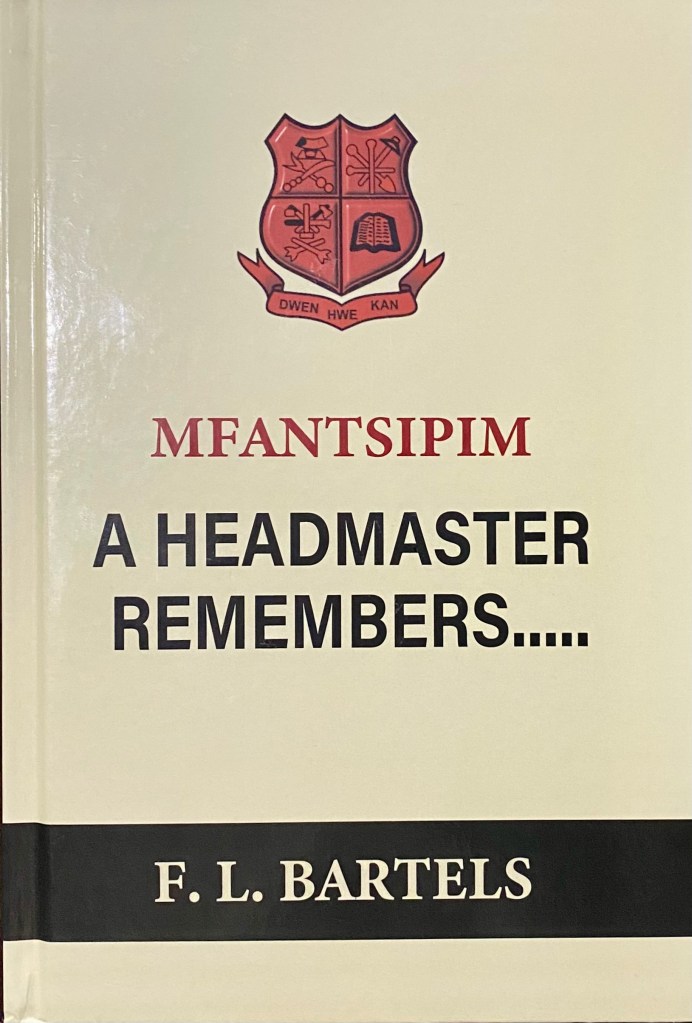
He later wrote me to announce the completion of this book we are about to launch today. At the time, he titled it, “A Long Winding Road”, and asked for my opinion. I did provide it by suggesting another title since, to me, a long winding road sounded like a long winding read. Thereafter, he was to change it to “Mfantsipim: A Headmaster Remembers”, a most appropriate title for the masterpiece.
He had once told me (He always called me by my last name) “Haffar, I will live a hundred years”. [He lived exactly 100yrs and one week].
Before his passing, in March 2010, he had asked me to write his final paper to be delivered on his hundredth birthday. And I said, “Why me? I don’t think I can do this!” He replied, “Haffar, YOU know me”.
I dutifully wrote something and sent it to him. He sent an email and thanked me for it, and said, “I need to write the paper myself. It’s going to be my very last contribution to education. And I will like you to read it on my behalf.”
I was soon to receive from him a paper titled, “Build Your Monuments in the Hearts of Men,” which I read on his behalf – to celebrate his 100th anniversary – at the Physicians and Surgeons, Accra. I then published it in my book, “Mfantsipim: The Makers of a Great School.”
I recall a question I put to him, once: I said, “Sir, who would you consider the most influential headmasters of Mfantsipim?” He replied: “I will give you only three names – Balmer and Lockhart. Now, YOU add the third!”
Today, I confess, I miss him more than ever. Whenever visiting Mfantsipim, I have stood and taken pictures by the monument of his bust with the plinth: “He sought to make as greater than himself.”
In summary, Headmaster Bartels taught me to stand on my own two feet and – most importantly – to think for myself. He taught me to take my thoughts seriously and document my ideas and work. On that advice, as I stand before you this evening, I’ve written well over 500 articles for my column, Education Matters, in the Daily Graphic, and in my blog, and published three books. He made my life complete. And I’m forever grateful to him.
Email: anishaffar@gmail.com
copyright© 2016-2025, anishaffar.org
Discover more from
Subscribe to get the latest posts sent to your email.
 anishaffar.org